
Beating On-Chain Forensics: How Bubblemaps and Arkham Cluster Solana Wallets
Public ledgers never forget. Learn how blockchain intelligence tools cluster your sub-wallets, track funding roots, and how using isolated vanity addresses with clean gas hygiene preserves on-chain anonymity.
SolRefinery Research
On-Chain Forensics Team
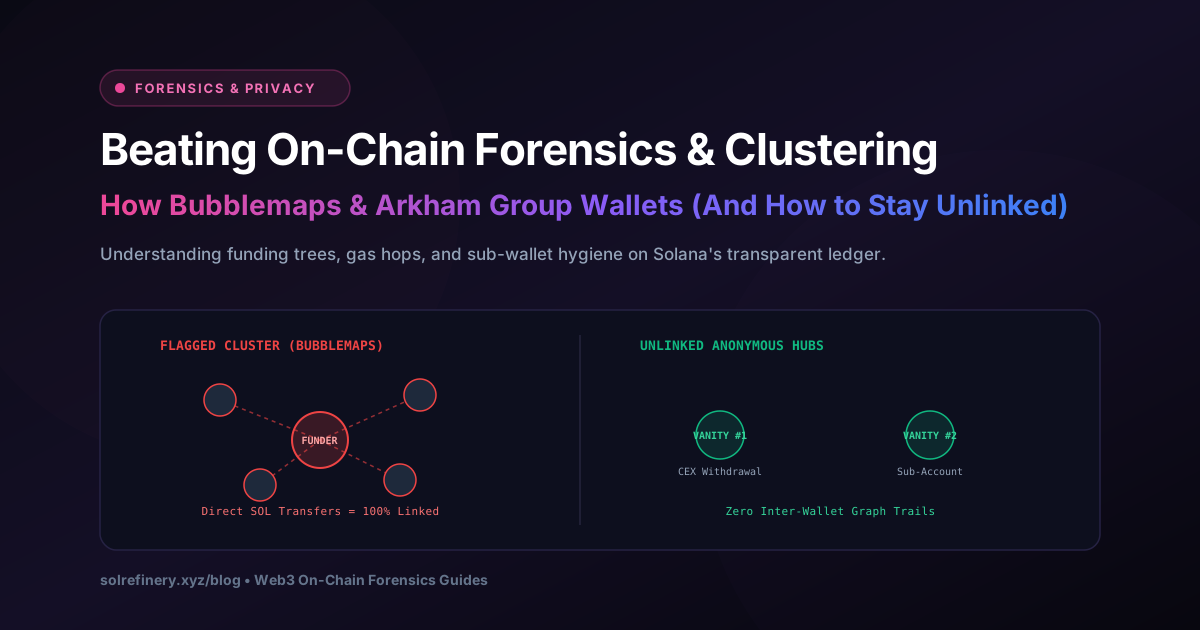
Solana’s sub-second finality and negligible transaction fees make it the premier blockchain for high-frequency trading, DeFi arbitrage, and token launches. However, these same properties make Solana a goldmine for on-chain intelligence firms like Arkham, Chainalysis, and visual graph platforms like Bubblemaps. Every SOL transfer, SPL token mint, and liquidity deposit leaves an immutable fingerprint. If you manage multiple wallets, chances are your addresses are already clustered and linked to your primary identity. Here is how modern clustering algorithms work, and how you can architect cryptographic separation.
1. The Mechanics of Blockchain Graph Clustering
Blockchain intelligence tools do not rely on guesswork; they use graph theory and deterministic heuristics. In a transactional graph, wallets are nodes and transactions are directed edges. The most common clustering heuristic is the "Common Funder" rule.
If Wallet A sends 0.05 SOL to Wallets B, C, and D for transaction fees (gas), graph algorithms immediately cluster B, C, and D under the same controlling entity. Even if you use separate browser profiles or different VPN IP addresses, the on-chain funding trail permanently unmasks your multi-wallet cluster.
Transferring funds between wallets within the same block or across sequential slots creates a temporal signature. Automated sniper bots and tracking bots flag these transactions with over 95% statistical confidence.
2. The Danger of "Dust" and Return Routing
A widespread mistake among traders and protocol operators is the "return sweep". A user carefully funds 5 separate trading wallets through a centralized exchange (CEX) to prevent clustering. However, when closing their positions, they sweep all remaining profits or dust SOL back into a single main treasury wallet.
This single return transaction instantly binds all 5 wallets together into a single cluster on Bubblemaps. Once linked, any historical trades or token launches associated with those addresses are permanently mapped to your profile.
3. Clean Hygiene: Breaking the Cluster Chain
To maintain true operational security (OpSec) on Solana:
1. Never fund multiple secondary wallets from an existing personal wallet. Always route initial funding through a tier-1 Centralized Exchange (CEX) hot wallet pool, or use non-custodial privacy mixers that decouple deposit and withdrawal addresses.
2. Utilize unique vanity addresses for distinct activities: dedicate one branded vanity keypair exclusively to public treasury operations, another to private trading, and a third to contract deployment.
3. Never consolidate dust tokens back to a shared address. Treat each vanity wallet as an autonomous financial silo.
Conclusion & Key Takeaways
On-chain transparency is a double-edged sword. While it enables trustless verification, it completely strips away user privacy unless deliberate clustering countermeasures are taken. By understanding how forensics graphs trace edges, you can safeguard your transactions from public profiling.