
Seedless Cold Storage: How Steganography Eliminates Crypto Drainer Attacks
Paper seed phrases get photographed, and digital notes get hacked by malware. Discover how StegoSol uses AES-256 and LSB image steganography to conceal Solana private keys inside everyday digital photos.
SolRefinery Research
Cybersecurity Lab
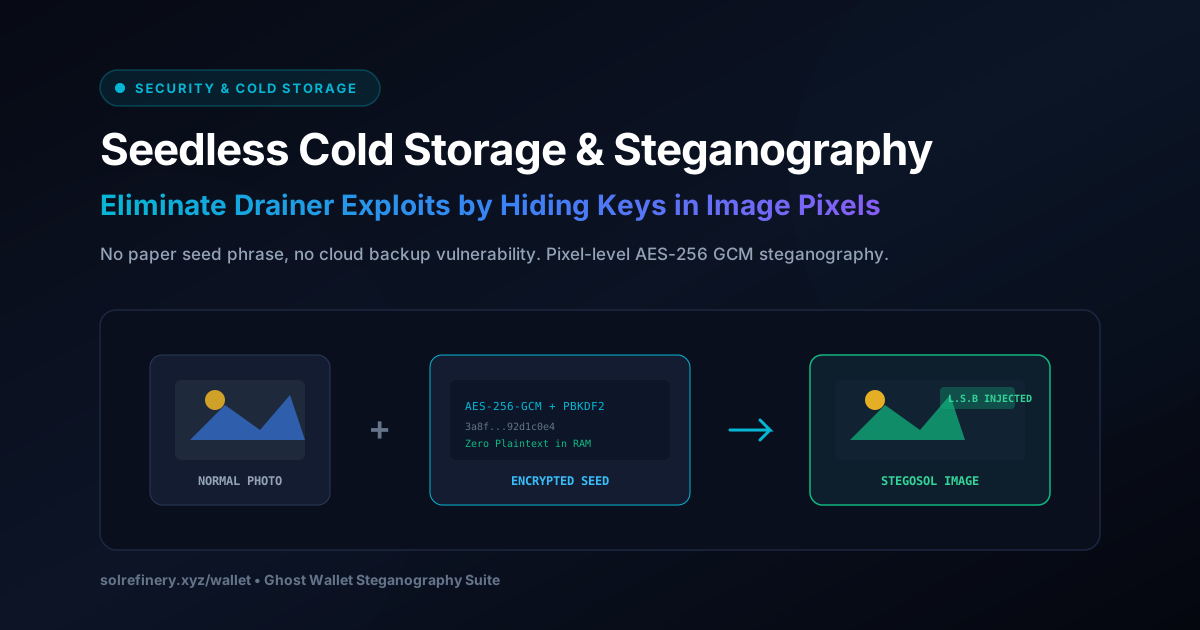
Crypto wallet drainers, phishing clipboard hijackers, and cloud backup intrusions account for hundreds of millions of dollars in stolen digital assets every year. The vulnerability is almost always the same: human storage of the 12 or 24-word seed phrase. Whether written in a notebook, screenshot on a phone, or stored in password managers, plaintext seed phrases are low-hanging fruit for malicious software. In this paper, we explore seedless cold storage via image steganography—a technique that embeds encrypted cryptographic secrets within ordinary image files, rendering them completely invisible to both humans and automated malware scanners.
1. The Vulnerability of Traditional Seed Storage
Every standard BIP-39 mnemonic seed phrase converts entropy into a series of English words. The moment an attacker gains visual access to those words—via an infected mobile device, an automated iCloud/Google Photos backup sync, or malicious browser extensions reading system clipboards—your funds are irreversibly gone.
Hardware wallets provide strong protection against remote extraction, but physical seed backups remain an Achilles heel. If a burglar or curious visitor finds a piece of paper with 12 words, they need no technical expertise to drain the wallet.
Modern malware tools now use OCR scanners to automatically search users hard drives and cloud storage buckets for images containing BIP-39 word lists. Storing handwritten seeds in photos is no longer safe.
2. How Least Significant Bit (LSB) Steganography Operates
Steganography is the science of hiding secret data within an innocent-looking carrier medium. In digital photography, an uncompressed image (such as a PNG) is composed of millions of pixels, where each pixel has Red, Green, and Blue (RGB) color channels represented by 8-bit integers (values from 0 to 255).
The Least Significant Bit (LSB) is the 8th bit in each byte, responsible for only 1/256th (0.39%) of the total color intensity. By swapping the LSB of select color channels with the encrypted bits of a Solana private key, we can embed entire cryptographic credentials directly into the pixel matrix. The resulting visual difference (Delta E < 0.05) is completely imperceptible to the human eye and indistinguishable from natural camera sensor noise.
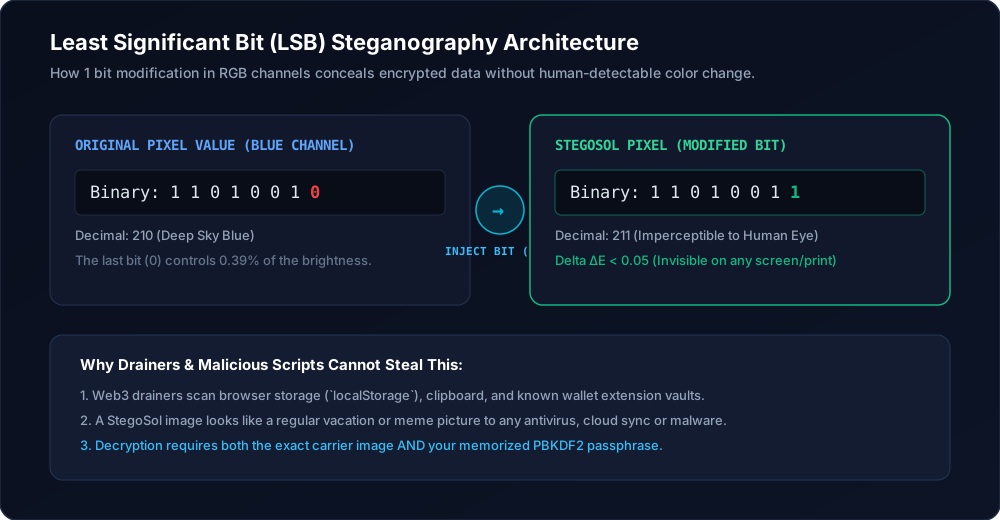
3. Dual-Layer Defense: PBKDF2 Key Derivation & AES-256-GCM
Never hide unencrypted plaintext inside an image. If a sophisticated forensic analyzer inspects the raw binary byte stream, statistical entropy spikes could reveal the presence of hidden text. StegoSol enforces a mandatory military-grade dual encryption pipeline before bit injection:
First, your custom passphrase is fed into PBKDF2 (Password-Based Key Derivation Function 2) with 100,000 SHA-256 iterations and a random cryptographic salt. This stretches the passphrase into a high-entropy 256-bit AES encryption key, rendering GPU brute-force dictionaries useless.
Second, the keypair payload is encrypted using AES-256-GCM (Galois/Counter Mode). GCM provides both high-speed confidentiality and cryptographic authentication: if even a single pixel of the carrier image is corrupted, compressed, or tampered with, decryption safely fails instead of producing corrupt keys.
A StegoSol file is simply a valid PNG photo. You can post it on social media, save it as your desktop wallpaper, or store it in your family photo album. Without your memorized passphrase, it is impossible for anyone to prove that the image contains hidden crypto keys.
Conclusion & Key Takeaways
Steganography bridges the gap between digital accessibility and physical security. By eliminating plaintext seed phrases and embedding encrypted keypairs within innocuous imagery, StegoSol creates a seedless cold storage paradigm that is resilient against both physical theft and automated Web3 drainers.