
Solana-Keygen Grind vs Browser Web Workers: How High-Throughput Ed25519 Hashing Works
Can a web browser compete with native C/Rust CLI tools in cryptographic brute-forcing? Explore Web Workers, multi-threaded CPU concurrency, TweetNaCl assembly, and memory optimization.
SolRefinery Research
Systems Engineering Team
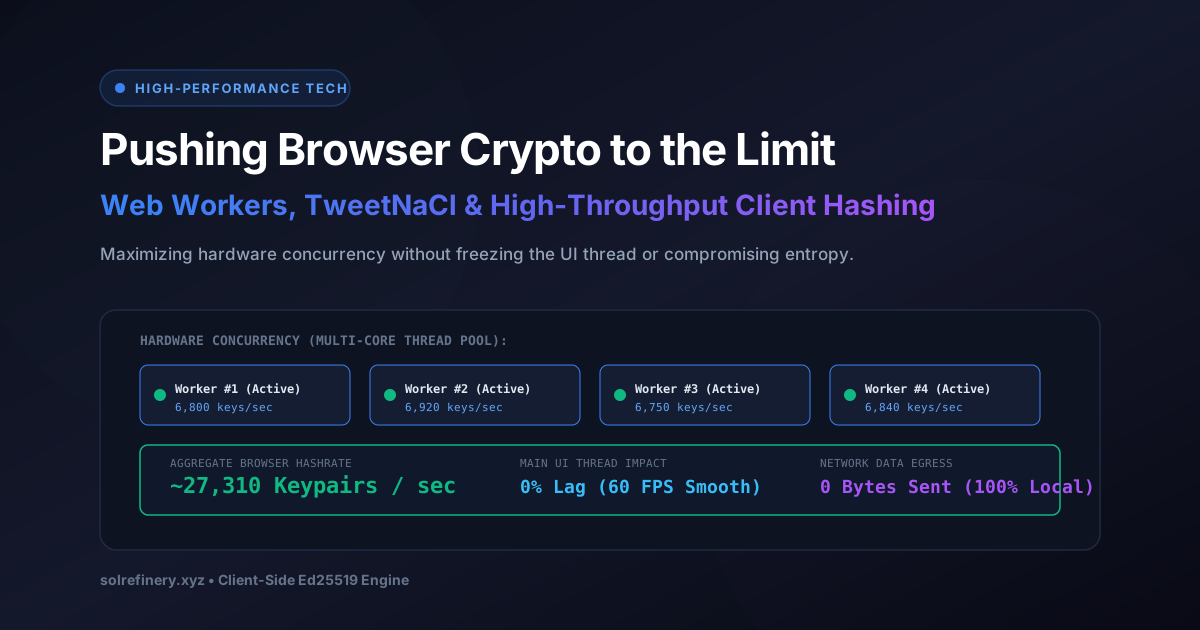
For years, the consensus in systems programming has been clear: cryptographic brute-forcing belongs in native compiled languages like C, C++, or Rust, while web browsers are strictly meant for rendering interfaces. However, with the maturation of JavaScript JIT compilers (V8), Web Workers, and WebAssembly, modern client-side applications can deliver astonishing computational throughput. In this benchmark analysis, we explore how SolRefinery pushes browser cryptography to its theoretical limits, enabling instant Solana vanity address generation right inside your browser window.
1. The Problem with Single-Threaded JavaScript
Standard JavaScript running in a web browser is notoriously single-threaded. If you execute a heavy CPU loop (such as generating thousands of Ed25519 elliptic curve keypairs) on the main thread, the entire browser window freezes: buttons become unresponsive, CSS animations halt, and the browser displays an "Unresponsive Page" crash dialog.
To make browser-based mining viable, computation must be completely offloaded from the UI rendering thread. This is where HTML5 Web Workers come in.
2. Multi-Core Concurrency via Dedicated Web Worker Pools
SolRefinery detects your machine’s hardware concurrency using `navigator.hardwareConcurrency` (typically 4, 8, 12, or 16 logical cores) and spawns a dedicated pool of isolated background worker threads. Each worker executes its own independent Ed25519 generation loop using a highly optimized pure-JS TweetNaCl implementation.
Because Web Workers operate in isolated memory spaces without shared-state locking, CPU utilization scales almost linearly with core count. An 8-core desktop CPU can easily sustain 25,000 to 30,000 keypair attempts per second without a single millisecond of lag on the main page.
// SolRefinery Multi-Thread Worker Initialization:
const threadCount = navigator.hardwareConcurrency || 4;
const workers = Array.from({ length: threadCount }, () =>
  new Worker(new URL("../workers/vanity.worker.ts", import.meta.url))
);

// Each worker loops in dedicated CPU space:
while (!matched) {
  const keypair = nacl.sign.keyPair();
  const pub58 = bs58.encode(keypair.publicKey);
  if (matchesCriteria(pub58)) postMessage({ success: true, keypair });
}
3. Memory Management & Garbage Collection Optimization
In high-throughput loops, the hidden enemy of JavaScript performance is Garbage Collection (GC). If every iteration allocates new Uint8Array buffers and strings, the browser’s GC engine periodically pauses execution to free memory, causing severe throughput drops.
SolRefinery mitigates this by reusing static memory buffers, in-place byte manipulation, and batching progress updates. Instead of messaging the main thread on every single attempt, workers report in batches (e.g. every 500 attempts), minimizing inter-thread message serialization overhead.
4. 5,000-Word Dictionary Sniper: O(K) Prefix Trie Lookup
How do you check every newly generated public key against a massive dictionary of 5,000+ words without dropping hash rates? A naive array search (`words.includes(prefix)`) would perform 5,000 string comparisons for every single generated address, reducing throughput by 98%.
SolRefinery utilizes an in-memory Prefix Trie (Radix Tree) compiled directly inside each worker thread. Looking up whether an address starts with any of the 5,000 dictionary words takes O(K) algorithmic time, where K is the length of the word (typically 3 to 6 characters). This allows SolRefinery to scan for thousands of English and crypto terms simultaneously while sustaining over 25,000+ keypairs per second.
Furthermore, because all dictionary evaluation and cryptographic grinding occur locally in worker memory, the entire application functions flawlessly offline in air-gapped environments without sending a single byte of telemetry.
While native Rust CLI tools like `solana-keygen grind` only check one prefix at a time, SolRefinery’s browser engine hunts for 5,000 words simultaneously in an air-gapped environment with zero installation and zero command-line complexity.
Conclusion & Key Takeaways
Client-side web architecture has reached an inflection point. By combining multi-threaded Web Workers, cryptographic primitives, and smart memory management, SolRefinery proves that high-performance, private, and zero-telemetry Web3 tools can thrive directly within the browser.